-
- No Comments
- August 25, 2026

Web Design and Development: 5 Proven Reasons Looks Fail
Web Design and Development: 5 Proven Reasons Looks Fail
Web design and development are often treated as two separate jobs, one for the person who makes things look good and one for the person who makes things work. That split is exactly why so many businesses end up with a beautiful homepage that quietly loses customers the moment they try to actually use it. A stunning layout can get someone to stop scrolling for a second, but it cannot fix a slow server, a broken checkout form, or a menu nobody can find on their phone.
This guide breaks down why web design and development have to move together, not in sequence, and what happens to your conversions when they don’t, along with the warning signs that your own site might already have this gap.
Why Web Design and Development Can’t Be Separated
Good web design and development work as one continuous process, not a handoff where a designer finishes a mockup and throws it over a wall to a developer. When design happens in isolation, you get gorgeous layouts that are technically difficult or slow to build correctly. When development happens without design input, you get fast, functional pages that feel cold and untrustworthy. Neither half can rescue the other.
A visually striking site with a three-second load time still loses roughly half its visitors before the page even finishes rendering, no matter how good that first frame looks. On the flip side, a technically fast site with cramped text, poor contrast, and no visual hierarchy struggles just as much, because visitors cannot quickly figure out what the business actually does or why they should stay.
Fixing this gap later is also far more expensive than getting web design and development right together the first time. A visual refresh applied on top of a slow, poorly structured codebase tends to inherit the same underlying problems, so the business ends up paying for two redesigns instead of one properly planned build.
5 Reasons Great Visuals Alone Won’t Save a Bad Website
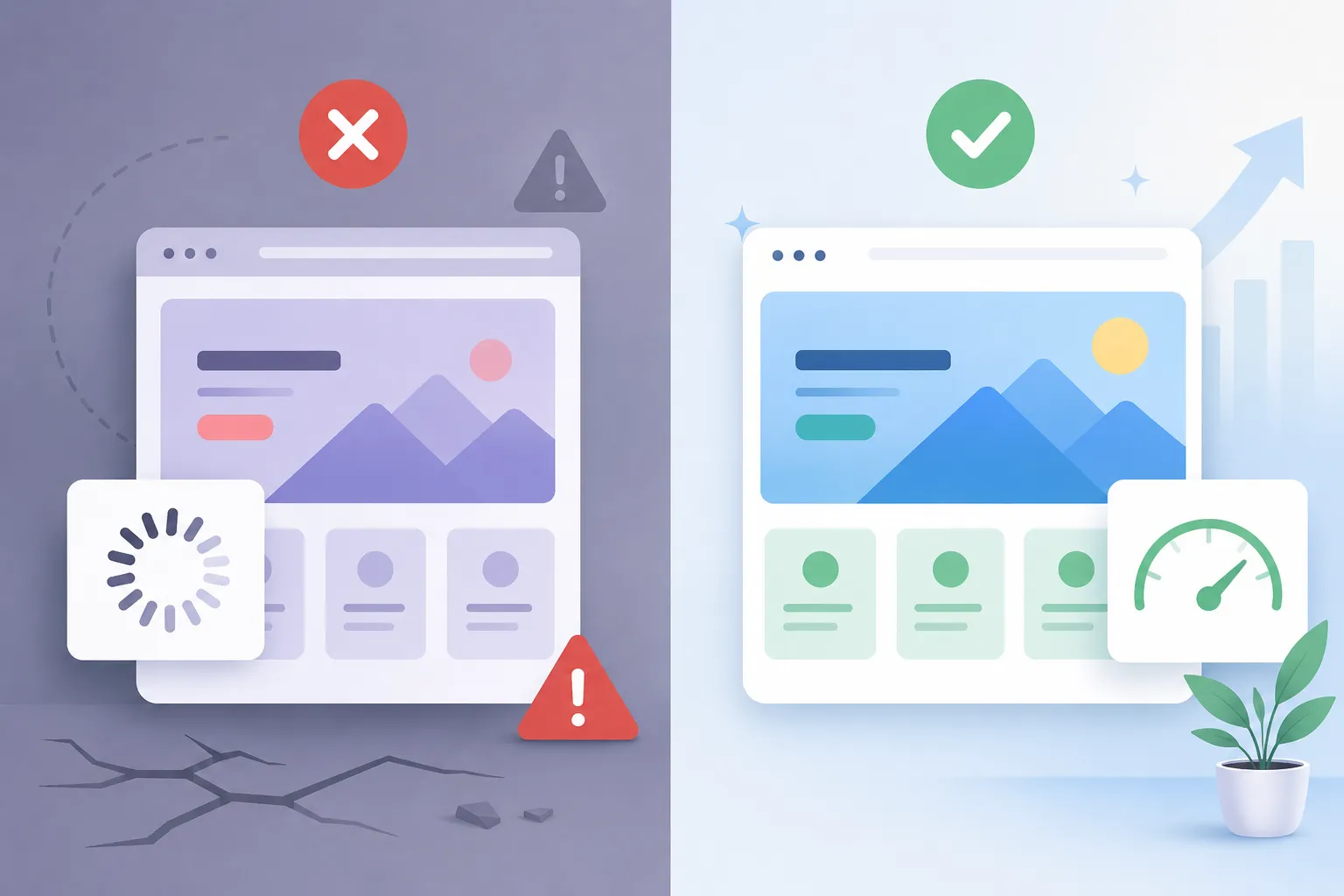
A polished design can only take a website so far. Here are five ways a weak technical foundation quietly undoes even excellent visual work, no matter how much time went into the layout itself.
- Slow backend performance — heavy images, unoptimized code, and cheap hosting can make a beautiful page feel sluggish, and visitors rarely wait around to admire the design.
- Confusing navigation — no amount of color theory fixes a menu structure that buries your services three levels deep where visitors give up looking.
- Poor mobile responsiveness — a layout that looks flawless on a designer’s monitor can break completely on a phone screen, where most visitors actually arrive.
- Broken functionality — a gorgeous contact form that fails to send, or a checkout button that does nothing, erases any trust the visuals built in the first place.
- Weak technical foundation — missing structured data, slow server response times, and poor site architecture quietly hurt both rankings and user experience regardless of how the site looks.
Any one of these can undo months of careful visual work in a matter of seconds, since a visitor who hits a broken form or a frozen page rarely scrolls back up to admire the typography. Multiply that across every visitor who has the same experience, and a single overlooked technical detail can quietly cap your conversion rate for months before anyone notices why.
How Web Design and Development Work Together to Convert
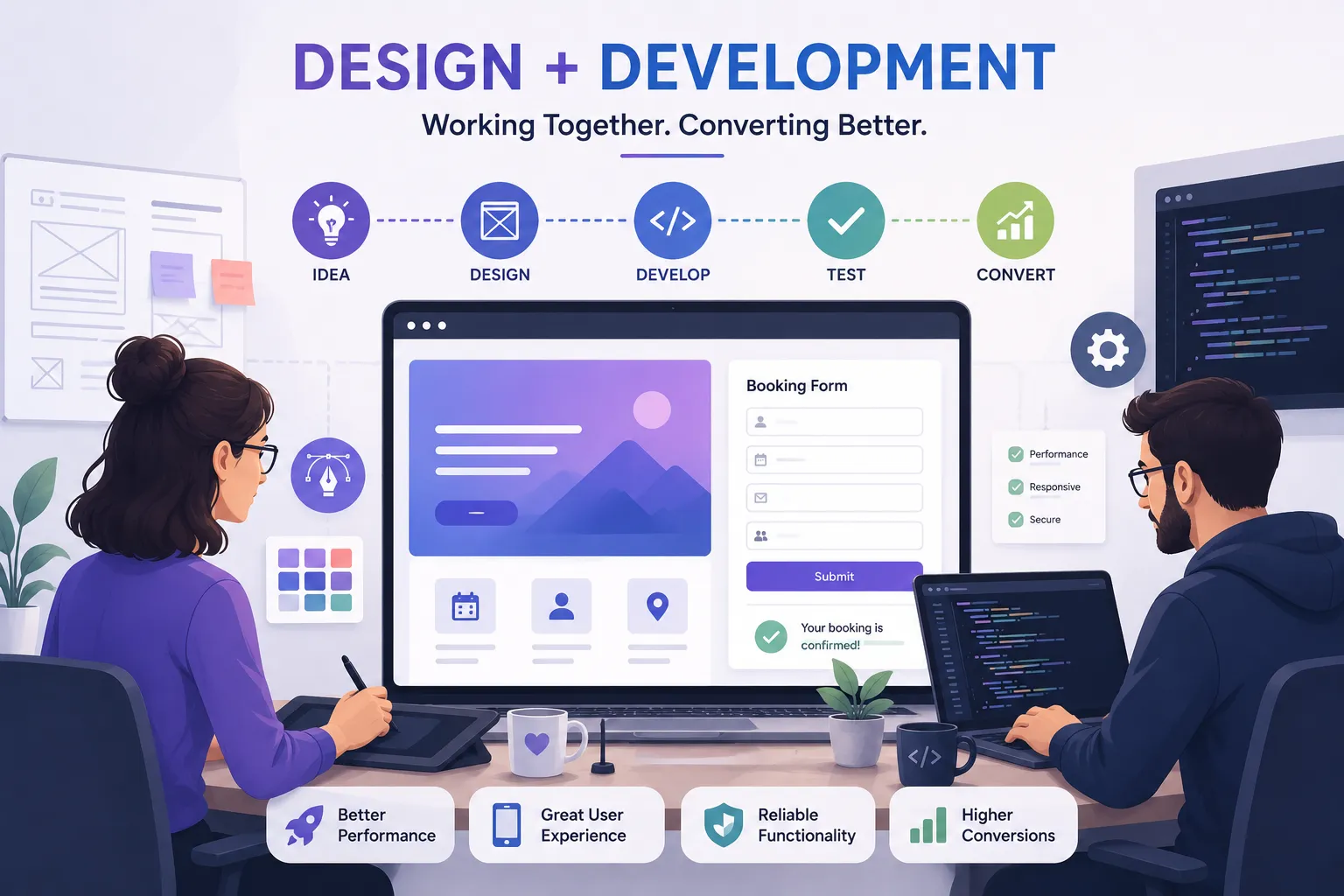
When web design and development are planned together from the start, every visual decision gets tested against real technical constraints before it ships. A designer choosing a large hero image knows the developer will compress and lazy-load it properly. A developer building a form knows exactly how it should look and behave because the design already accounted for error states and confirmation messages.
Consider a simple booking form. Designed without development input, it might look clean but silently fail on older phone browsers. Built without design input, it might work perfectly but confuse users about which fields are required. Planned together, it looks clear and it actually submits successfully every time. Working with a team that offers dedicated website development alongside design means these two sides are never guessing about each other’s plans, and updates after launch follow the same coordinated process instead of drifting apart again over time.
Signs Your Site Has a Design-Development Gap
A few warning signs tend to show up when design and development were handled separately, or by two teams that never really talked to each other. Pages that look perfect in a preview tool but break at real screen widths are one clue. Forms, filters, or interactive elements that look designed but behave inconsistently are another. So is a homepage that loads a full-screen video before showing any actual content, or buttons that visually suggest they are clickable but do not respond right away. Even small details, like a hover state that never changes or a dropdown menu that only works with a mouse, quietly signal that the visual layer and the functional layer were never fully tested together.
Pairing thoughtful graphic design services with solid development from day one avoids most of these gaps entirely, rather than patching them after launch. According to usability research from Baymard Institute, most conversion losses trace back to friction in how a site actually functions, not how it looks on the surface, which is exactly why the two disciplines need to be planned as one project rather than two.
Frequently Asked Questions
What does web design and development actually mean together?
Web design and development refers to the combined process of how a website looks and how it technically works, planned as one project instead of two separate handoffs.
Can a good design fix a slow website?
No. A slow website loses visitors regardless of how attractive the layout is, since most people leave before a slow page even finishes loading, no matter how the homepage is styled.
Do I need separate people for design and development?
Not necessarily. What matters is that both sides communicate closely and test decisions against real technical limits, whether that is one person handling both, or two collaborating teams working from the same brief and reviewing each other’s work regularly.
How do I know if my current website has this problem?
Test it on a real phone, fill out your own contact form, and time how long your homepage takes to load. Gaps usually show up quickly once you actually use the site yourself instead of just looking at it.
Is it worth rebuilding an old website instead of just redesigning it visually?
Often yes, especially if the underlying code is outdated or slow. A visual refresh alone rarely fixes performance or functionality problems hiding underneath it, so the improvement fades within a few months.
Conclusion
A beautiful website and a working website are not automatically the same thing. Web design and development need to move together from the first sketch to the final line of code, or you end up with visuals that impress for a moment and technical gaps that quietly cost you customers. Get both sides talking early, and every part of your site, from the first impression to the final click, actually holds up under real use, on any device, for any visitor who lands there.


