
-
- No Comments
- August 27, 2026

Website Audit Case Study: 6 Warning Signs to Consolidate
Website Audit Case Study: 6 Warning Signs to Consolidate
This website audit case study looks at something most agencies talk about for clients but rarely publish about themselves: our own blog. Like a lot of sites that have been publishing for years, ours had grown into a mix of strong, useful posts sitting next to older articles that no longer earned their place. Rather than keep adding new posts on top of that pile, we ran a full audit of our own content and consolidated a chunk of it.
Here is exactly what we looked for, how we decided what to merge or remove, and what happened afterward in this website audit case study, written the same way we would document this process for a client. We are sharing the real signals and the real decision framework, not just the result, because the process is what actually transfers to your own site.
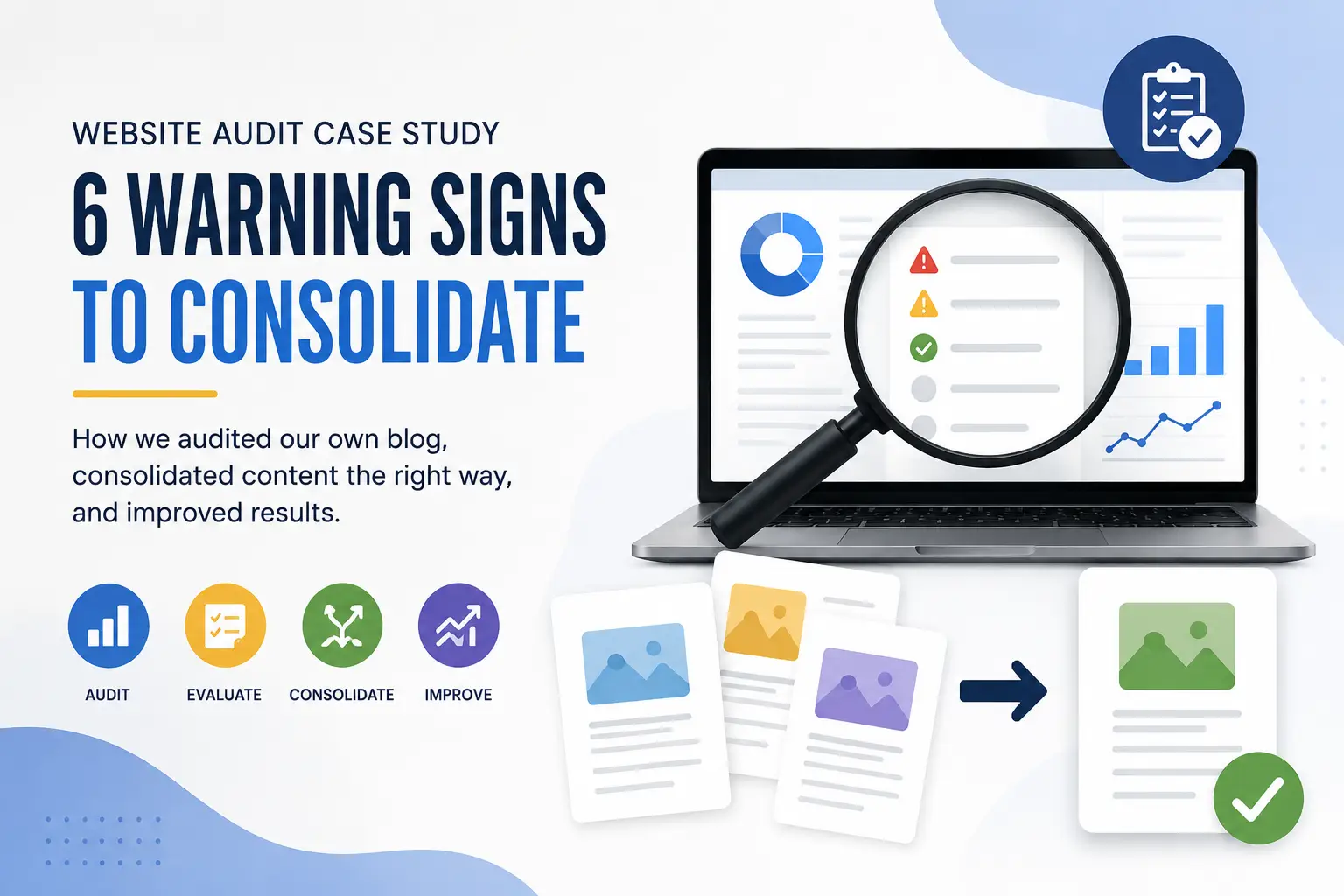
Why We Started a Website Audit Case Study on Our Own Blog
Every website audit case study starts with a simple question: is every page still pulling its weight? For us, the honest answer was no. Some older posts were still ranking and bringing in visitors. Others covered the same topic three or four different ways, written at different points over the years by different people, with none of them ranking particularly well because they were all quietly competing against each other.
It is easy to keep publishing new content and never look back at what already exists, especially once a blog has years of posts behind it. We treated our own blog the same way we would treat a client site: pull the data first, then decide, rather than relying on which posts we personally remembered fondly or assumed were still useful. The trigger for us was noticing that a handful of newer, better-researched posts were quietly underperforming older, thinner ones simply because those older posts were splitting the same search traffic between three or four near-identical pages.
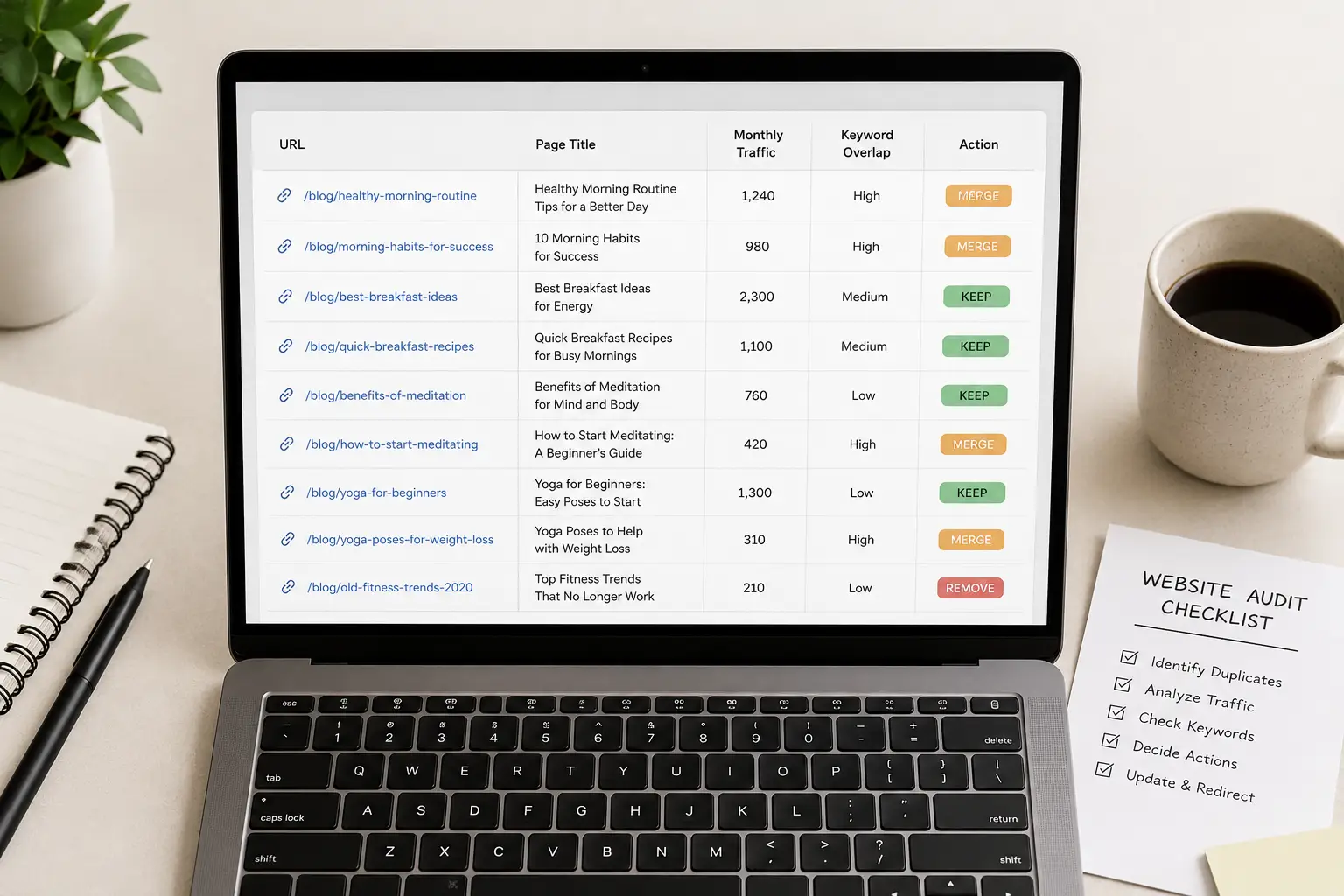
6 Warning Signs That Told Us It Was Time to Consolidate
We used six specific signals to flag posts for our audit, rather than relying on gut feeling about which articles “felt” outdated.
- Overlapping topics — multiple posts targeting the same or very similar keywords, splitting both traffic and ranking potential between them instead of building one strong page.
- Thin content — older posts that were short, surface-level, and never gave readers enough to actually act on.
- Outdated information — posts referencing old tools, old pricing, or old best practices that had since changed.
- Near-zero organic traffic — pages that Google Search Console showed getting little to no impressions or clicks over a long stretch of time.
- Duplicate intent — two or more posts effectively answering the same reader question, just with different titles.
- Cannibalization in search results — cases where our own pages were shown to be competing against each other for the same queries instead of one clear page ranking.
Once we pulled this data into a single spreadsheet, patterns became obvious fairly quickly. Certain topics had three or four posts fighting for the same handful of keywords, while other genuinely useful posts had simply been buried under newer, thinner content added on top of them over time. Google Search Console and our analytics platform did most of the heavy lifting here, since traffic and impressions over the last twelve months tell a much clearer story than opinions about which posts still feel relevant.
How We Decided What to Merge, Refresh, or Remove
Not every flagged post got deleted. We sorted everything into three buckets. Posts with real traffic and solid information got refreshed with updated details and better structure. Posts covering overlapping ground got merged into one comprehensive, better-organized guide, with old URLs redirected to the new page so nothing lost its existing authority. Posts with no traffic, no backlinks, and no unique value got removed entirely.
This step took longer than expected in this website audit case study, mostly because merging content properly means more than copying paragraphs into one document. Each merged guide needed its own structure, its own updated examples, and a clear point of view instead of reading like three old posts stitched together end to end. Running this kind of audit alongside broader search engine optimization work made it easier to prioritize which pages actually mattered for rankings, rather than treating every post as equally important.

What Changed After the Consolidation
The most immediate change was simply having fewer, stronger pages instead of many thin ones competing with each other. Readers landing on a merged guide got a single, complete answer instead of being routed between several partial ones. Our internal linking also became easier to manage, since related topics pointed to one authoritative page instead of three competing options, and updating a single guide going forward is far simpler than tracking changes across several overlapping posts.
According to Semrush’s own guidance on content pruning, sites that regularly prune and consolidate tend to see organic traffic recover and climb within a few months, since search engines can evaluate fewer, higher-quality pages more clearly. That pattern matched what we saw in our own website audit case study, with the merged guides gradually outperforming the sum of the older posts they replaced. Pairing this kind of audit with ongoing content writing work keeps the blog from drifting back into the same overlapping mess a few years down the line.
Frequently Asked Questions
What is a website audit case study?
A website audit case study documents the process of reviewing a site’s existing content or pages, deciding what to keep, merge, or remove, and what changed as a result of those decisions, so other site owners can apply the same framework.
How do you decide which blog posts to consolidate?
We look at overlapping topics, thin or outdated content, traffic and ranking data, and whether multiple pages are competing for the same search queries in Google.
Does consolidating blog posts hurt existing rankings?
When done correctly, with proper redirects from old URLs to the new consolidated page, most sites keep or improve their existing rankings rather than losing them over time.
How often should a website run a content audit?
Smaller blogs can audit content once or twice a year, while larger, frequently updated blogs benefit from reviewing performance every few months instead of waiting for years of overlapping posts to build up.
Is content consolidation only useful for blogs?
No. The same audit approach applies to service pages, landing pages, and any part of a website where content has grown without a clear plan behind it.
Conclusion
A website audit case study is really just an honest look at whether your content is still working for you. For us, that meant admitting some of our own older posts were doing more harm than good sitting there half-finished and half-ranking. Consolidating them into fewer, stronger pages made our own blog easier to navigate, easier to maintain, and easier for search engines to understand.
If your blog has grown for years without a cleanup, the same six signals are worth checking on your own site too, before you publish another post on top of the pile instead of fixing what is already sitting there.


