-
- No Comments
- October 12, 2026

Facebook Ads for Local Businesses: A Practical Guide
Facebook Ads for Local Businesses: A Practical Guide
Facebook Ads for Local Businesses can help shops, salons, educational institutes, hotels, restaurants and service providers reach potential customers in their target markets. The key is to build campaigns around a clear business objective, a relevant offer and a reliable way to measure enquiries or sales.
A campaign that generates likes and clicks may create visibility without producing customers. A better approach connects audience selection, ad creative, lead capture, follow-up and conversion tracking into one process.
This guide explains how to plan, launch and improve Facebook advertising campaigns for local businesses across India, including practical examples for different industries.
Why Facebook Ads Matter for Local Businesses
Facebook advertising gives businesses a way to introduce their products or services to people who may be interested in them before they actively search for a provider. Campaigns can be configured around business goals, audiences, locations, budgets and available ad placements.
For local businesses, the main benefits include:
- Local awareness: Introduce a shop, clinic, salon, hotel or academy to relevant audiences in its service area.
- Lead generation: Collect enquiries through eligible instant forms, messaging experiences or a website.
- Appointment bookings: Promote consultations, salon appointments, trial classes or hotel enquiries.
- Product promotion: Showcase products, seasonal offers and new arrivals.
- Measurable performance: Evaluate spending against enquiries, qualified leads, bookings and sales when appropriate tracking is in place.
Facebook and Instagram ads are managed through Meta’s advertising tools. The best placement and campaign setup depend on the audience, creative and objective; neither platform guarantees conversions.
For businesses looking for professional support with campaign planning and execution, explore social media marketing services.
Choose the Right Campaign Objective
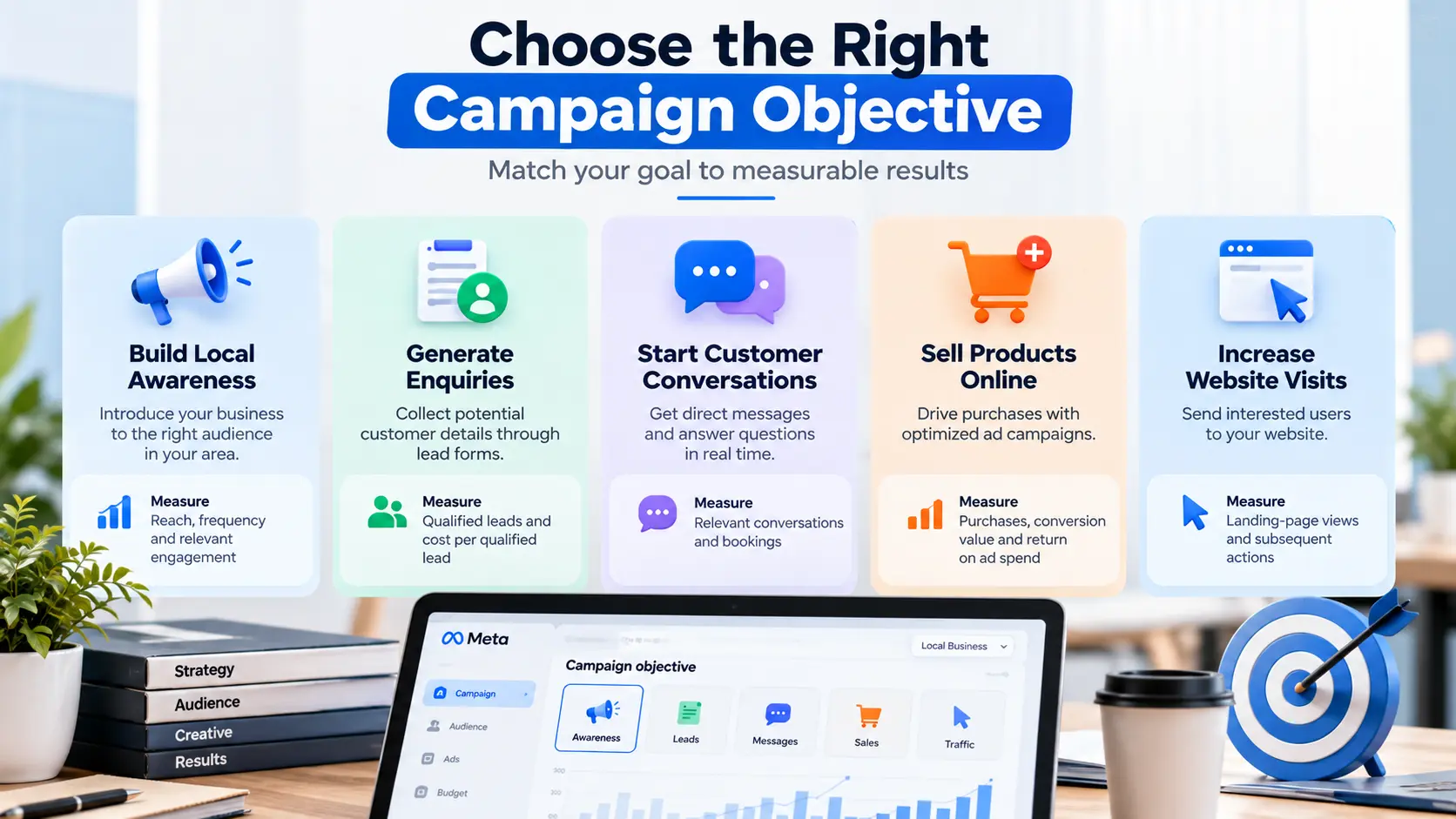
Before creating an ad, decide what action you want a potential customer to take. Your objective should match the business outcome you can realistically measure.
| Business goal | Campaign approach | What to measure |
|---|---|---|
| Build local awareness | Awareness | Reach, frequency and relevant engagement |
| Generate enquiries | Leads | Qualified leads and cost per qualified lead |
| Start customer conversations | Messaging setup available within the relevant objective | Relevant conversations and bookings |
| Sell products online | Sales | Purchases, conversion value and return on ad spend |
| Increase website visits | Traffic | Landing-page views and subsequent actions |
The available objectives, performance goals and destinations may vary as Meta updates its advertising interface. Refer to the official Meta Ads Guide for current ad formats and setup options.
Lead generation campaigns
Facebook Lead Generation Ads can use eligible instant forms to collect contact details and qualifying information without requiring a person to complete a separate website form. Depending on the campaign setup, leads can also be directed to a website or another supported contact destination.
For example, a coaching institute could ask prospective students for their preferred course, city and intended joining date. A salon could ask which service the person wants to book.
Keep forms short enough to encourage completion but detailed enough to help your team assess the enquiry.
Businesses that need help improving enquiry quality can also review lead generation services.
Messaging campaigns
Messaging can be useful when customers need answers before making a decision. A salon may need to discuss availability, while a hotel may need travel dates and guest numbers.
Use a clear opening message, relevant quick replies and a defined follow-up process. Measure meaningful conversations and confirmed bookings rather than treating every message as a sale.
Sales campaigns
E-commerce businesses should focus on measurable purchase actions when their website, product catalogue and tracking setup support them. Track completed orders and revenue rather than relying on clicks or add-to-cart events alone.
How to Set Up Facebook Ads Step by Step
Step 1: Prepare your business assets
Before launching a campaign, confirm that you have:
- A business Facebook Page with accurate contact information.
- Access to Meta Ads Manager and the appropriate business assets.
- A suitable payment method and correct billing details.
- A website, lead form or messaging destination appropriate to the campaign.
- A clear offer, creative assets and a plan for responding to enquiries.
If you are sending traffic to a website, review the landing page on mobile devices. It should load properly, explain the offer clearly and make the next action easy to complete.
Where the campaign requires a dedicated landing page, professional website development services can help businesses create a suitable website experience.
Step 2: Define your ideal customer
Describe the people most likely to buy from you. Consider their location, needs, purchasing stage and the service they require.
A dance academy might target families within a realistic travelling distance. A hotel might target people planning trips to its destination. An e-commerce store shipping across India would need a different audience and delivery strategy from a neighbourhood retailer.
Use relevant audience controls where available, but avoid adding unnecessary restrictions without evidence that they improve results.
Step 3: Select the campaign objective
Choose the objective based on your primary outcome: enquiries, conversations, purchases or awareness.
Avoid selecting an objective simply because it appears inexpensive. A low-cost click does not necessarily lead to a qualified enquiry or a paying customer.
Step 4: Configure the audience and budget
Set your geographic coverage, audience parameters, placements and budget according to your business model. Start with a test budget that you can afford to spend while learning.
If the business serves a small area, a tightly relevant geographic audience may be appropriate. If it sells online across India, restricting the campaign to the neighbourhood around its office would be counterproductive.
Step 5: Create the ad
Use a clear headline, a relevant visual, one main benefit and a specific call to action.
For example, a coaching institute could promote a trial class with a message such as “Explore Our Upcoming Courses — Enquire Today.” A retailer could highlight a particular product range rather than advertising every product in a single creative.
Make sure the offer, eligibility conditions and any stated price are accurate.
Step 6: Publish and monitor
Review the preview, destination, form fields, budget and tracking before publishing. Once the campaign is active, check delivery and conversion data regularly.
Do not make frequent changes simply because the first few hours produce limited results. Use sufficient data to identify meaningful patterns, while addressing clear setup errors or unexpected spending immediately.
Facebook Ads Targeting for Local Customers
Geographic targeting is one of the most important considerations for a local campaign. However, the correct service area depends on how customers reach the business.
Set a realistic service area
Consider travel time, delivery coverage, customer density and the value of the service. A neighbourhood salon may need a relatively compact audience. A specialist academy or destination hotel may attract customers from much farther away.
Use the geographic controls available in Ads Manager and verify that the campaign reaches areas the business can actually serve. Platform targeting does not guarantee that every person reached lives permanently in the selected area.
Match audience size to your offer
Audience targeting should reflect the product or service being advertised.
- A children’s academy should communicate with the relevant decision-makers and explain the programme clearly.
- A restaurant could promote a nearby dining offer or a time-sensitive event.
- A B2B service provider may need a more specific message addressing business needs.
- An online store may need broader coverage, supported by delivery availability and purchase data.
Do not assume that adding more interests will automatically improve performance. Test audience approaches against the same business outcome and compare the quality of the resulting leads.
Use retargeting where appropriate
With the necessary audience size, permissions and tracking setup, businesses may be able to reconnect with eligible website visitors or people who have engaged with their content.
Retargeting can help remind potential customers about a product, course or booking. It should complement customer acquisition rather than replace it, and it must follow applicable privacy requirements and platform policies.
Facebook Lead Generation Ads: How to Improve Lead Quality
Generating a high number of enquiries is not enough if most people are irrelevant, unreachable or unwilling to buy.
Use the following process to improve lead quality.
Write an offer that filters for intent
Be specific about the service, location, eligibility and next step. An academy could state the course level and upcoming intake. A service business could explain the type of consultation available.
Clear information helps potential customers decide whether the offer is relevant before submitting an enquiry.
Ask useful qualifying questions
Keep the form concise. Depending on the business, useful questions might include:
- Which service or course are you interested in?
- Which location do you prefer?
- When are you planning to purchase or enrol?
- What is the best way to contact you?
Collect only information that is necessary for the enquiry and handle personal data appropriately.
Follow up consistently
Assign new enquiries to a responsible team member, record their status and respond promptly during stated business hours. A structured process should distinguish new leads, contacted leads, qualified opportunities, bookings and completed sales.
If the business receives many low-quality leads, investigate the targeting, offer, form questions and sales follow-up together. Do not assume that changing the audience alone will fix the problem.
For businesses that need a more structured approach to acquiring and managing enquiries, see lead generation services from Advide Solutions.
Facebook Ads Budget for Local Businesses
There is no universal budget that guarantees results. Costs vary with competition, location, audience, creative quality, campaign objective and the action being measured.
A sensible budget starts with the economics of the business.
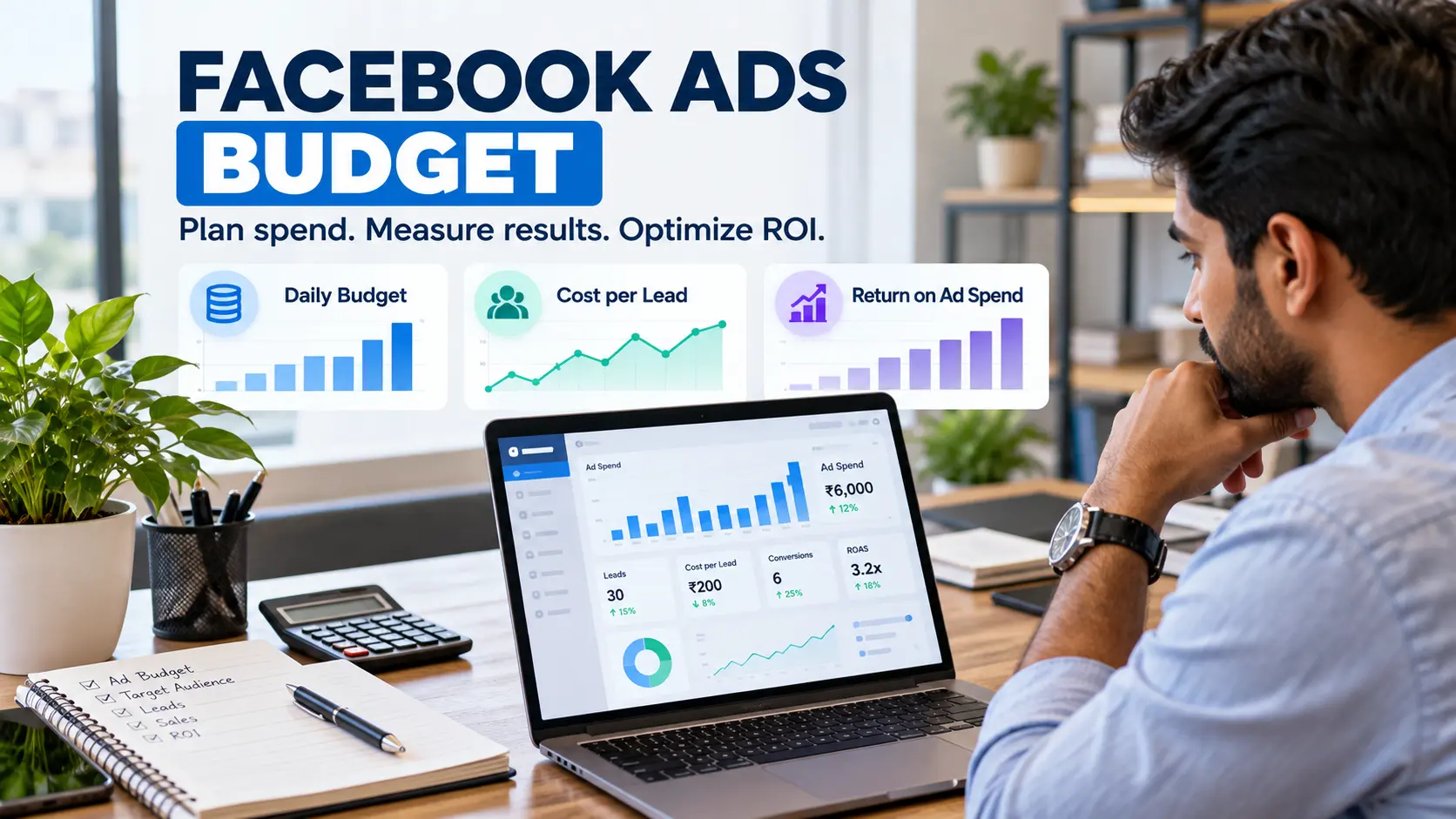
Suppose a business can spend ₹6,000 on a test campaign. If it receives 30 enquiries, its cost per enquiry is ₹200. However, if only six enquiries are qualified, the cost per qualified lead is ₹1,000.
These figures are illustrative calculations, not industry benchmarks or promised results.
Use these formulas to evaluate performance:
- Cost per lead: Total ad spend ÷ total leads.
- Cost per qualified lead: Total ad spend ÷ qualified leads.
- Lead-to-customer rate: Customers acquired ÷ total leads × 100.
- Customer acquisition cost: Relevant acquisition costs ÷ new customers acquired.
Include agency fees and other acquisition costs when calculating the full cost of acquiring a customer. Keep ad spend and service fees separate when comparing campaign performance.
Before increasing the budget, check whether leads are relevant, follow-up is working and sales are being recorded accurately.
Ad Creative That Connects with Local Customers
A strong local ad makes the offer easy to understand and gives the audience a reason to act.
Use relevant visuals
Show the real product, service, premises, team or experience whenever possible. A salon could demonstrate a service, a school could introduce its facilities and a retailer could show how a product is used.
Avoid generic visuals that do not represent the business. Use authorised images and obtain appropriate permission before featuring identifiable people.
Write clear ad copy
A useful structure is:
- Audience or need: Identify the relevant customer problem.
- Offer: Explain what the business provides.
- Reason to act: Communicate a genuine benefit or useful detail.
- Call to action: Ask the reader to enquire, book, shop or learn more.
For example:
“Looking for a new course for your child? Explore our available programmes, check the class schedule and speak with our team to find the right option. Enquire today.”
Adapt the wording to the actual programme and do not add unsupported claims about outcomes.
Businesses that need help developing campaign messaging can explore professional content writing services.
Test creative variations
Test a small number of meaningfully different concepts, such as a product demonstration versus a customer-focused explanation. Keep the offer and measurement method consistent enough to make the comparison useful.
Evaluate the cost and quality of the resulting enquiries, not only likes, views or click-through rate.
Industry-Specific Facebook Advertising Examples
Salons and beauty businesses
Promote specific services, appointment availability or seasonal packages. Use authentic service visuals and direct users to a suitable booking or messaging destination.
Measure completed bookings and attended appointments, not just messages received.
Schools and coaching academies
Highlight course details, teaching formats, upcoming batches and enquiry options. Use forms that collect the information required for an admissions conversation.
Track qualified admissions enquiries and enrolments. Avoid implying guaranteed academic outcomes unless a claim is properly substantiated and compliant with applicable policies.
For a broader education-sector strategy, see digital marketing for educational institutions.
Hotels and hospitality businesses
Promote the property, amenities, destination and booking options. Include accurate availability information and direct interested users to a booking page or enquiry channel.
Measure completed bookings and booking value wherever tracking permits.
Retail and e-commerce stores
Use product-focused creatives, accurate pricing and clear delivery information. Online stores should connect advertising data to purchase data wherever possible.
Track purchases, revenue, average order value and return on ad spend rather than evaluating success through engagement alone.
Professional and local service businesses
Explain the service area, the problem addressed and what happens after an enquiry. A clear consultation process can help users understand the next step and improve lead qualification.
Track qualified enquiries, appointments and completed sales.
Tracking, Testing and Optimization
Campaign optimization requires reliable measurement. Where a website is involved, review the available Meta Pixel and Conversions API options, configure appropriate events and verify that recorded conversions correspond to actual customer actions. Refer to the Meta Business Help Center for current tracking and advertising documentation.
Use consistent campaign naming and UTM parameters so that website analytics can distinguish traffic sources and campaigns. Check for duplicate events, missing tracking and discrepancies between ad-platform reports and actual enquiries. Google’s campaign URL builder guidance explains how campaign parameters can be used to identify traffic sources.
Review performance across several levels:
| Metric | What it tells you |
|---|---|
| Reach and frequency | How broadly and how often people see your ads |
| Click-through rate | How effectively the creative encourages clicks |
| Landing-page conversion rate | How often relevant visitors complete the desired action |
| Cost per qualified lead | How efficiently the campaign generates relevant enquiries |
| Lead-to-customer rate | How well enquiries turn into customers |
| Customer acquisition cost | How much it costs to acquire a customer |
| Return on ad spend | How much attributed revenue is generated per unit of ad spend |
Do not judge campaign profitability from a single metric. For example, a campaign with a higher cost per lead may still be more valuable if it generates customers with higher purchase values.
Review the results, identify the most likely bottleneck, make a controlled adjustment and measure the effect. Avoid changing the audience, budget, creative and landing page simultaneously when you need to understand which change affected performance.
Common Facebook Ads Mistakes to Avoid
Choosing the wrong objective: Optimizing for engagement when the actual goal is qualified enquiries can produce misleading results.
Targeting an unrealistic area: Reaching people outside the service or delivery area can waste budget.
Using vague offers: Ads that do not explain the service, audience or next step make it harder for customers to decide.
Ignoring lead follow-up: Delayed or inconsistent responses can reduce the number of enquiries that become customers.
Measuring only cheap leads: Low cost does not automatically mean high commercial value.
Skipping conversion tracking: Without reliable measurement, it becomes difficult to identify which campaigns contribute to sales.
Making unsupported claims: Promises of guaranteed leads, sales or specific returns create unrealistic expectations and can undermine trust.
When to Hire Facebook Ads Campaign Management Services
Managing campaigns internally can work when a business has the time, expertise and systems to handle setup, creative testing, tracking and lead follow-up.
Professional Facebook Ads Campaign Management Services may be worth considering when campaigns spend consistently but fail to generate qualified leads, reporting is unclear, or the business needs coordinated advertising and landing-page improvements.
Before choosing a provider, ask how they define a qualified lead, what reporting they supply, how conversion tracking is handled and who owns the ad account and creative assets.
Advide Solutions provides digital marketing services including social media marketing, lead generation, SEO and website development. Businesses can review the relevant social media marketing services to understand which areas of support match their requirements.
The right approach is not simply to spend more on ads. It is to connect the campaign objective, audience, offer, lead handling and measurement to a clear business outcome.
Conclusion
Facebook Ads for Local Businesses are most useful when the campaign is designed around the way customers actually discover, evaluate and purchase a product or service. Start with a clear objective, choose a relevant audience, communicate a specific offer and measure qualified leads or sales.
As the campaign gathers reliable data, improve the elements that have the greatest effect on business results. For local businesses across India, a disciplined approach to targeting, creative testing, follow-up and conversion tracking provides a more useful basis for growth than chasing engagement alone.
Frequently Asked Questions
1. Do Facebook Ads work for local businesses?
Yes. Facebook Ads can help local businesses build awareness, generate enquiries, promote offers and drive sales. Results depend on the audience, offer, campaign objective, follow-up and measurement setup.
2. How much should a local business spend on Facebook Ads?
There is no fixed amount that works for every business. Set a test budget based on what you can afford to learn, your expected customer value and the cost of acquiring a customer. Increase spending only when performance supports it.
3. How can I get local customers through Facebook Ads?
Define your service area, select a suitable campaign objective, promote a relevant offer and make the next action clear. Track qualified enquiries and sales, then refine the campaign based on actual results.
4. What are Facebook Lead Generation Ads?
Facebook Lead Generation Ads are campaigns designed to collect potential customers’ information through supported lead forms or other eligible lead destinations. Businesses can use qualifying questions to assess whether an enquiry is relevant.
5. Are Facebook Ads better than Google Ads for local businesses?
Neither is universally better. Facebook Ads can introduce offers to audiences who may be interested, while Google Search Ads can reach people actively searching for a product or service. The right choice depends on customer intent, competition and campaign economics.
6. How do I measure Facebook Ads success?
Measure the metrics that reflect your business goal. For lead generation, track qualified leads, cost per qualified lead and lead-to-customer rate. For e-commerce, track purchases, revenue and return on ad spend.
7. Do I need a website to run Facebook Ads?
Not always. Depending on the available campaign setup, businesses can use eligible instant forms or messaging destinations. A website becomes particularly useful when you need detailed service information, online bookings, checkout or website-based conversion tracking.
8. When should I hire a Facebook Ads agency?
Consider professional support when you need help with campaign strategy, creative testing, lead quality, conversion tracking or ongoing optimization. Review the provider’s reporting process and ensure your business retains appropriate access to its advertising assets.


