-
- No Comments
- June 8, 2026

Google AI Search 2026: Powerful SEO Strategies to Rank in AI Overviews
Search is not dead. It is just changing shape.
Google AI Search 2026 is transforming the way users discover information online. With AI Overviews becoming more common in search results, businesses need to adapt their SEO strategies to stay visible and competitive.
Why this matters for businesses
A lot of business owners are asking the wrong question. They are asking, “How do I beat AI?” That is the wrong frame.
The better question is, “How do I make my website useful enough that Google wants to surface it in new search experiences?” Google’s documentation shows that it continues to expand reporting and guidance around generative AI visibility, which tells you this is not a side experiment anymore. It is becoming part of how searchperformance is measured and understood.
What AI Overviews actually change
AI Overviews are designed to give users a quick summary of a topic, while still linking out to supporting sources. Google has said these experiences draw from web sources and can show a wider range of links, which means businesses can still earn clicks if their pages are strong enough to be included or referenced. In practice, this means the winners are not the loudest brands. They are the clearest, most useful, most trusted ones.
The old SEO game is not gone
A lot of people think AI search has killed SEO. That is lazy thinking.
Google says the best practices for SEO remain relevant for AI features in Search because those features are rooted in the same core ranking and quality systems. So the job is still the same at its core: make pages that are easy to crawl, easy to understand, and genuinely helpful for people.
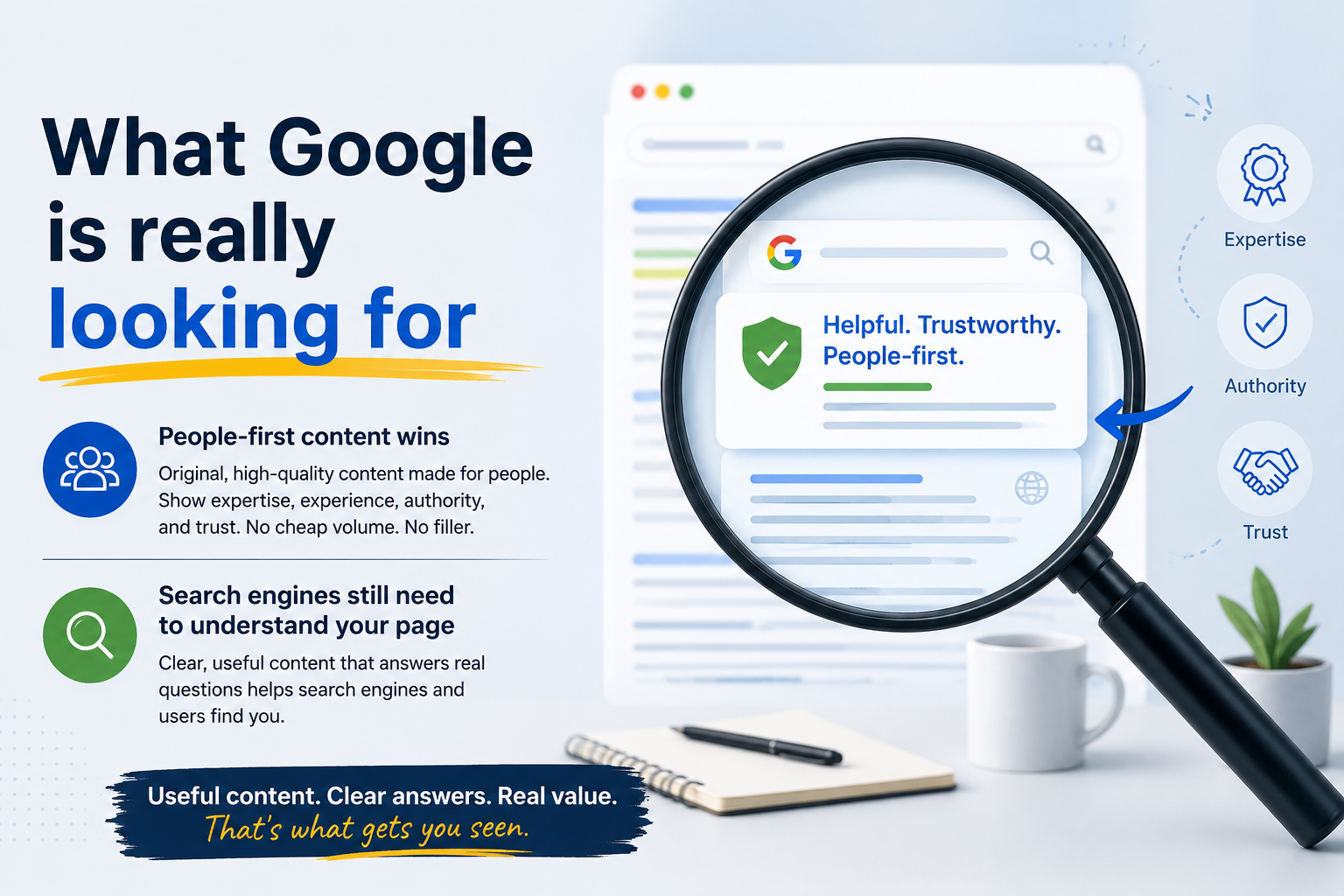
What Google is really looking for
People-first content wins
Google AI Search 2026 guidance is very blunt here: it wants original, high-quality content made for people, not content written only to manipulate rankings. It also says ranking systems aim to reward content that shows expertise, experience, authoritativeness, and trustworthiness. That is the standard now. Not cheap volume. Not filler. Not copied garbage with keywords stuffed into every paragraph.
Search engines still need to understand your page
SEO is still about helping search engines understand your content so users can find it. That sounds basic, but most websites still fail at it. They talk too much, say too little, and bury the useful answer under weak headlines, vague claims, and bloated paragraphs. If Google cannot clearly understand what your page is about, you are making ranking harder for yourself.
How businesses can rank better in Google AI Search in 2026
1) Write for intent, not just keywords
People do not search in neat little keyword boxes. They search with doubts, problems, and comparisons.
A good page should answer the real question behind the query. For example, if someone searches “best digital marketing agency in Jaipur,” they are not just looking for a name. They want proof, services, pricing logic, case studies, trust signals, and a reason to contact you. That is what strong content should deliver. Search-friendly content matters because it helps more relevant users find your site.
2) Build topic depth, not random blog posts
One blog can bring traffic. A content cluster can build authority.
Instead of writing ten disconnected articles, build one main topic and support it with related posts. For example:
- SEO for local businesses
- Google Ads for service companies
- Instagram marketing for small brands
- Website design for lead generation
- How to improve conversion rate on landing pages
That structure helps users move naturally from one useful page to another, and it helps search engines understand what your site is actually about. This is exactly the kind of clarity Google’s SEO guidance encourages.
3) Make your content easier to trust
Trust is not a design trick. Trust is built through proof.
Show who wrote the content. Add practical examples. Mention experience. Include screenshots, steps, checklists, or results when possible. Google’s people-first guidance is clear that helpful content should demonstrate genuine expertise and usefulness, not just keyword targeting.
4) Keep pages simple and readable
If your content looks like a wall of text, most people will leave.
Short paragraphs, clear headings, and direct explanations matter. Google’s SEO starter guide exists because structure helps both users and search engines understand content faster. That means your page should not feel like a thesis. It should feel like a useful conversation.
A better way to write your sections
Start with the answer.
Then explain it.
Then prove it.
That simple format works better than dramatic intros and long fluff paragraphs. People do not come to your site to admire your writing style. They come for information, clarity, and solutions.
Keep your examples close to the reader
If you are writing for local business owners, use local examples. If you are writing for service brands, talk about leads, calls, bookings, and visibility. The more your content sounds like it was written for a real person with a real problem, the better it will perform.
Small detail, big difference
Even tiny improvements in clarity can make your content feel more trustworthy. A page that is easy to scan usually performs better than one that tries too hard to sound “professional” and ends up sounding cold.
What not to do
Do not publish thin blog posts just to “stay active.”
Do not copy competitor articles and change a few words.
Do not stuff “SEO in 2026” into every heading like that alone will make you rank.
Do not rely on generic AI-style writing that says a lot and means very little.
Google AI Search 2026 guidance on AI-generated content is not about banning AI. It is about quality. The search system is meant to reward original, useful content, regardless of how it was produced. Low-value mass content is the problem, not the tool itself.
A practical content formula that works
Choose one main search problem
Pick one problem your audience genuinely has. Do not try to solve everything in one article.
Give the direct answer first
Do not hide the answer under three paragraphs of setup.
Add examples and proof
Use examples from local businesses, service brands, or common marketing mistakes.
End with a clear next step
Tell readers what to do next: audit their site, fix their titles, improve their content, or review their local SEO setup.
Conclusion
SEO in 2026 is no longer just about ranking for keywords—it’s about becoming the most reliable source of information for your audience. As Google continues integrating AI into Search, businesses that prioritize helpful content, user experience, and trust will have the greatest opportunity to gain visibility.
Instead of looking for shortcuts, focus on understanding your customers, solving their problems, and creating content that genuinely helps them make better decisions. The businesses that consistently provide value will not only perform well in traditional search results but will also be better positioned to appear in Google AI Overviews and future AI-powered search experiences.
The future of SEO belongs to brands that put people first. If your content helps users, answers their questions, and demonstrates real expertise, you’ll be well-prepared for the evolving search landscape in 2026 and beyond.
Frequently Asked Questions (FAQs)
What are Google AI Overviews?
Google AI Overviews are AI-generated summaries that appear at the top of search results, helping users find answers quickly while linking to relevant websites.
Can my website appear in AI Overviews?
Yes. Websites with high-quality, helpful, and well-structured content have a better chance of being featured in AI-powered search results.
Is SEO still important in 2026?
Absolutely. SEO remains essential because AI search still relies on quality content, website authority, user experience, and relevance.
Does AI-generated content hurt SEO?
Not necessarily. AI-assisted content can rank well if it is accurate, valuable, and properly edited for users. Low-quality or spammy content is what causes problems.
How can businesses rank in Google AI Search 2026?
Focus on creating original content, answering user questions clearly, improving website experience, and demonstrating expertise within your industry.


